The Ohtani Game
Contextualizing the unbelievable

Two vintage performances took place in Game 4 of the 2025 NLCS that deserve our attention. Many have already written about these two gems in the immediate wake of the Dodgers’ 5-1 series clincher over the hapless Brewers, and many more will do so in the future. And for good reason—they were both electric. So, let’s break down how they compare to some of the greatest performances in the sport’s history.
The first was delivered by the starting pitcher for the Dodgers, Shohei Ohtani. Ohtani began his outing fiercely, striking out the side in the top of the first. Seven more Ks were accumulated by the end of the 6th inning, and he had given up no runs. Returning for the 7th proved a bit too risky in hindsight as he surrendered a walk and a single before Dave Roberts relieved him, but a timely double play induced by Alex Vesia thankfully kept Ohtani’s runs allowed number nice and round. His final line: 6.0+ IP, 10 K, 2 H, 3 BB, 0 R/ER. This yielded a Game Score of 75, firmly top 10 among all starts in this postseason so far (though coincidentally only third-best among his rotation-mates in the series). Nevertheless, a fantastic outing.
The second was from L.A.’s lead-off hitter, Ohei Shohtani. Shohtani hit a home run off José Quintana in the first, drew a walk against him, hit another home run off Chad Patrick, and then hit another home run off Trevor Megill. All three homers were solo shots, all were struck off three different pitch types, and all were launched at least 425 feet, with the furthest being the second at 469 feet. That has an exceptional argument for best game by a hitter this postseason. Three-homer games are special, with only a little over 500 having occurred in a major league game before. Perhaps most notable is that in a postseason full of wall-scrapers, each of Shohtani’s bombs were utter no-doubters. That kind of power is matched by very few in today’s game.
So we have a top-10 start this postseason and also a nearly perfectly optimized outing with the bat. These were two great games, but I would hesitate to say they’re two of the best ever. We’ve seen perfect games before; we’ve seen four-homer games before. The bar is pretty high. If you want to make an argument for best single game performance ever, you’re going to have to raise the stak-
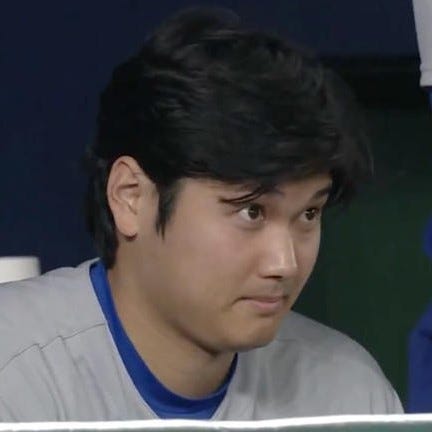
Okay, I am a bit of a fibber. The Dodgers don’t actually employ a guy named Shohei Ohtani and also a different guy whose name happens to be a spoonerism of Shohei Ohtani. Incredibly, a convincing argument could be made that such a humorous coincidence would be more believable than reality. But the reality is monolithic: They are one. Shohei Ohtani is one of one. Shohei Ohtani is unbelievable.
Fans of baseball have been fortunate to witness many incredible games this postseason, from Skubal’s dominant flamethrowing, to Guerrero Jr’s bat-to-ball brilliance, to young phenoms Schlittler and Yesavage shocking with stunning maturity on the mound, to Judge’s Herculean effort to keep his Empire from crumbling. Adjectives abound for these performances: good, great, amazing, wonderful, surprising… but ultimately, believable.
Meanwhile, Ohtani had been feeling the October chill, insofar as a dominant two-way player in 2025 can. He did earn a quality start in the Division Series and hit some homers in the Wild Card round, but Sho Time had yet to fully manifest. Well, last night, it did. Those two vintage performances described earlier were brought to life by the same man in the same game, nearly single-handedly punching his team’s ticket to the World Series. Now that is some “best game ever” material.
Another stunning performance that has been brought to fans’ attentions due to Ohtani’s alien outing is that of Rick Wise. On June 23, 1971, Wise started on the mound for the Phillies against a middling Reds at Riverfront (they were not quite The Big Red Machine yet). He completed a no-hitter with 3 strikeouts and only 1 walk (for a Game Score of 89), and also went 2-for-4 from the plate with 2 home runs! This was not the first time a pitcher hit multiple home runs in a game, but the no-hitter certainly adds a lot of mystique here.
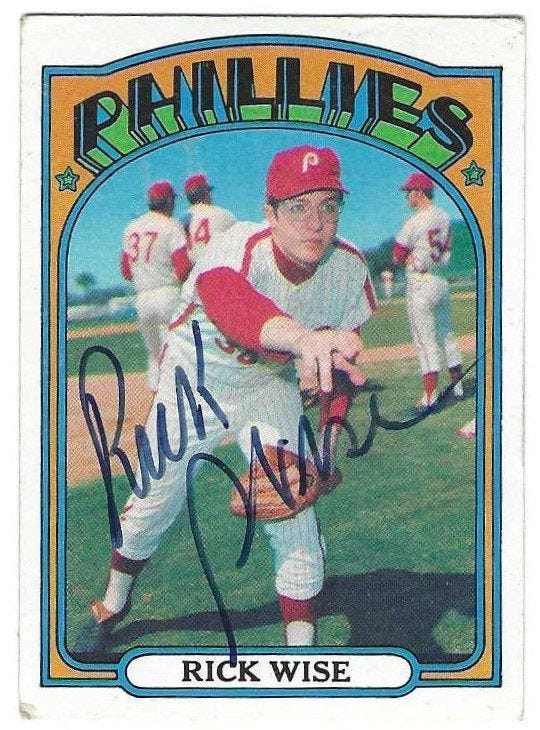
Comparing Ohtani’s and Wise’s games feels like comparing a Pagani Huayra to a Koenigsegg Agera. Would you rather have nine more pitching outs, two less hits, and two less walks, or seven more strikeouts, one more home run, and two less hitting outs? Wise’s outing on the mound was certainly more impressive, but only 3 Ks indicates he probably benefited from some batted ball luck. Meanwhile, Ohtani was more powerful and efficient with the bat. Wise pitched a no-hitter, and was one walk away from a perfect game. Ohtani accomplished his feat in the Championship Series instead of early in the regular season.
If we’re to take Game Score at face value, Wise’s pitching performance was 14 points better than Ohtani’s. Does Ohtani’s additional walk and homer (with two less outs made as a batter) make up for that difference? We can use the lesser known Batting Game Score (also invented by Bill James) to figure this out. From Baseball Reference:
Start with 0 points. Add 40 points for a cycle, 30 for a 3-HR game and 10 for a 2-HR game. Add 1 point for each run, RBI, 2B, SB, BB, and HBP recorded. Add 2.5 for each hit, 3 for each 3B and 4 for each HR. Subtract 1 for each CS and GIDP, subtract 2 for each error, 0.2 for each SO and 0.5 for each AB.
Wise: 4 ABs (-2), 2 H (5), 2 HR (8), 2 R (2), 3 RBI (3), two-homer bonus (10)
= -2 + 5 + 8 + 2 + 3 + 10 = 26. Adding 89 from pitching = 115 Total Game Score
Ohtani: 3 ABs (-1.5), 3 H (7.5), 3 HR (12), 3 R (3), 3 RBI (3), 1 BB (1), three-homer bonus (30)
= -1.5 + 7.5 + 12 + 3 + 3 + 1 + 30 = 54. Adding 75 from pitching = 129 Total Game Score
This method indicates Ohtani’s game was more impressive. However, Game Score is imperfect. Wise gets no extra points for throwing a no-hitter here, and Ohtani gets no extra points for his more opportune timing for his team’s championship odds. These are merely heuristics that may be outdated from when they were invented. For instance, if we removed the multi-HR game bonuses, Ohtani’s score would come down to a slightly more earthly 99 and fall short of Wise’s 105.
Trying to best Ohtani’s feat with context is possible as well. Sure, it happened in the Championship Series, but it could’ve happened in a tenser spot than up 3-0 against an uncharacteristically lifeless one-seed. Perhaps a winner-take-all postseason game, or even a World Series game. Bob Gibson’s complete game victory with a home run in Game 7 of the 1967 World Series comes to mind as one that surpasses Ohtani not in isolation, but in context of the championship. Orel Hershiser’s shutout without getting out at the plate in Game 2 of the 1988 World Series also surpasses Ohtani contextually, and comes closer than Gibson’s in isolation.
We could also zoom out to performances that were so dominant on one side of the ball that doing anything on the other didn’t matter. How about Don Larsen’s perfect game in Game 5 of the 1956 World Series, the only postseason perfect game in history? Or Jack Morris’s ten-inning shutout in a tense winner-take-all in 1991? Or Reggie Jackson’s three home runs to propel the Yankees to another trophy in 1977?
There are many ways to slice this pie. Inviting context into the discussion is well and good, but Ohtani’s performance being so complete in isolation cannot be understated. If the aforementioned postseason gems get an A in isolation and an A+ with context, Shohei’s gets an A+ in isolation and an A with context. Another point in Ohtani’s favor is that he didn’t just pitch and happen to need to bat, like his pre-DH ancestors. He is explicitly paid to succeed in both. His two-way excellence is not by circumstance, but by design.
In my view, nothing surpasses what I saw last night. And WAR agrees: If we were to calculate WAR according to the Fangraphs formula, Ohtani’s would be about 0.8, which would reportedly be the highest single-game total ever—more than his bombastic 50/50 clincher against Miami last season (which was “The Ohtani Game” until last night). Add in the fact that it occurred deep in the postseason and you have something which I believe has never been matched before.
Baseball’s rich and well-documented history is a gift that shouldn’t be taken for granted. The fact that we can compare Shohei’s performance last night with games from 1986 or 1886 if we want to is special, and has been made possible by many hard-working individuals who care deeply about this sport. To compare Ohtani’s game last night to the very best ever is a testament to the history he just made. Whether you believe it’s the best game ever or the seventh, his spot among them will never be supplanted.