Grounding kwERA
Literally!

Sometimes, that’s all you need! When it comes to evaluating pitchers, that is. Since those two variables stabilize so quickly in relation to most other metrics, and since they also resemble generally good pitching, K-BB% (and its twin in ERA form, kwERA) is a trusty stat to turn to 30% of the way through the season.
The beauty of K-BB%/kwERA lies in how simple it is whilst retaining its effectiveness. The modification we are about to make to it is not so simple, so if you prefer elegance above all else, kwERA is definitely enough for you. However, implementing just one other variable to the equation arguably improves its accuracy. That variable is ground ball percentage.
GBkwERA
Just over a decade ago, Jeff Zimmerman published what I perceive as a foundational article of modern pitching sabermetrics. In it, he dives not only into how well kwERA rivals other stats like FIP, xFIP, and SIERA, but also what kwERA misses in relation to ERA:
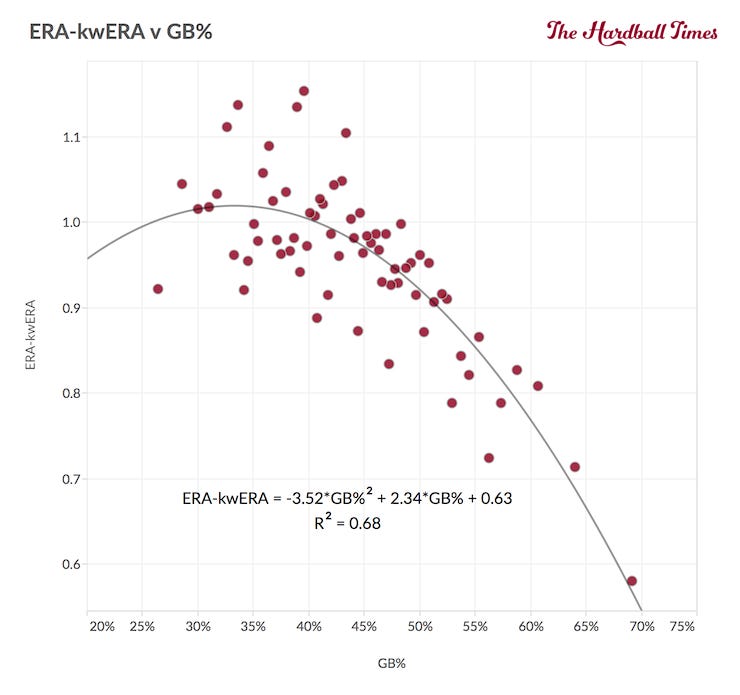
The above chart was published in that article, so all credit to Zimmerman. What it shows is the relationship between 1) the difference between ERA and kwERA, and 2) GB%. Clearly, there is a significant relationship between the two, which leads us to believe that GB% fills a need in the run prevention space that kwERA misses. Specifically, pitchers with a GB% around 30-40% especially tend to be represented a little more poorly by kwERA.
To rectify this, the formula for GBkwERA was created:
GBkwERA = kwERA * (-3.518*GB%^2 + 2.344*GB% + 0.629)
You’ll have to forgive me as I use this exact version for our purposes in 2026, even though this regression was derived back in 2015. Although the coefficients here are certainly not the same as they are today, they are probably close enough for our purposes.
Five years following Zimmerman’s contribution, Jason Fixelle converted kwERA and GBkwERA into their respective WAR counterparts. This analysis was illuminating as it showed that even though kWAR is a bit more stable year-over-year than gWAR (to be expected with the addition of an extra variable), gWAR predicts future fWAR about just as well, and predicts future RA9 even better.
Knowing this, let’s see how pitchers so far in 2026 stack up, not only by kWAR, but by gWAR as well:
Cristopher Sánchez’s recent CGSO helped propel him to the top of this list, where he’s trailed by sensational youngsters Misiorowski and Schlittler. Also notable is Mason Miller, whose 1.3 kWAR and gWAR see him at #35 on this list despite only pitching in relief.
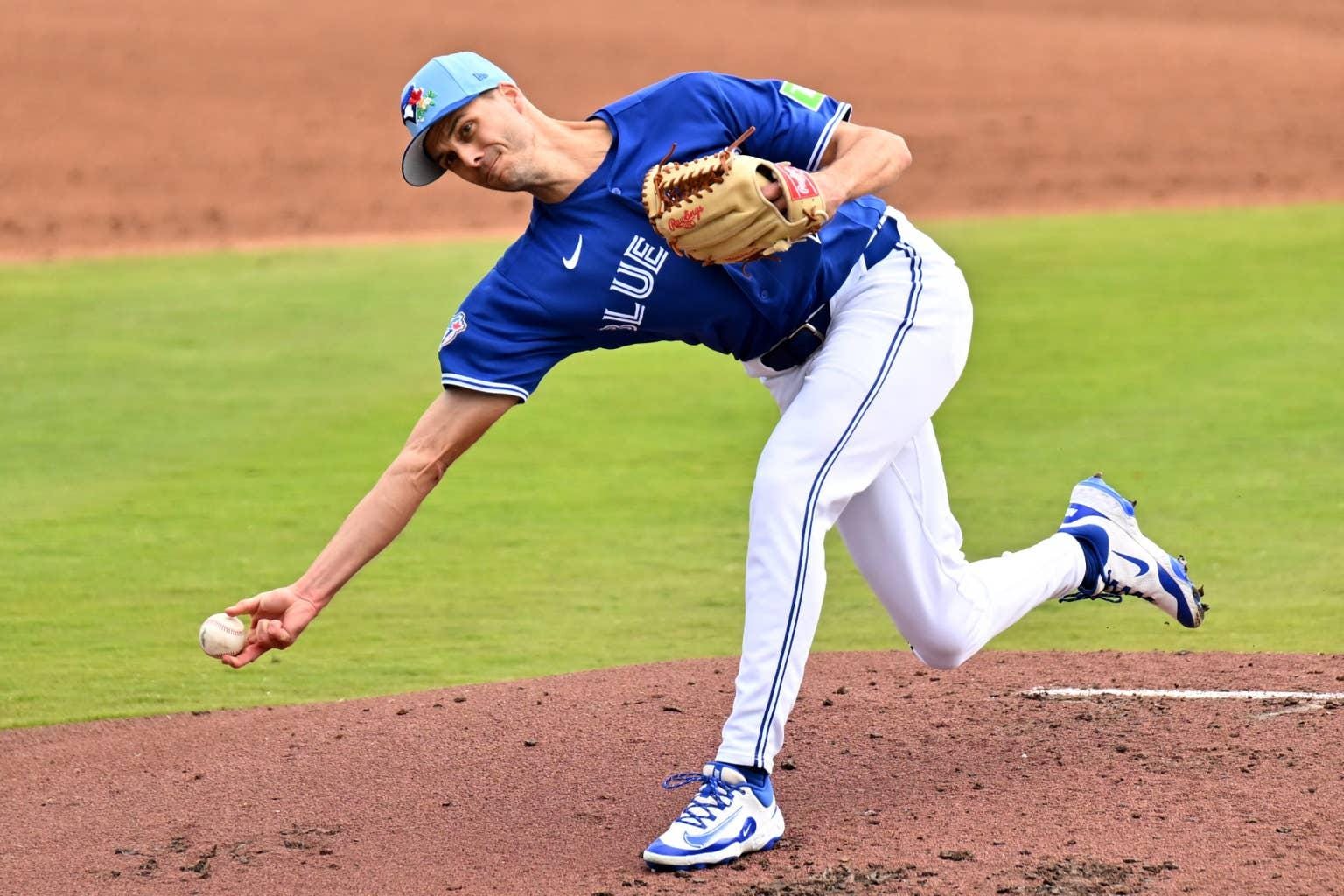
Sorting by “k-g” (the difference between kWAR and gWAR) is a useful exercise in that it highlights those pitchers whose relationship between their ability to induce grounders and their ability to prevent runs is particularly extreme. The most drastic differential belongs to Tim Hill, whose lefty sidearm style has always benefited his GB% immensely. Jack Kochanowicz and Tyler Rogers follow; Jack’s arm angle isn’t anything crazy, but Tyler’s…
That’s all! I’ll definitely incorporate gWAR/GBkwERA into my pitching analyses moving forward alongside their simpler counterparts.
Seeing Misiorowski and Schlittler this high already validates something I wrote about back in February with their SPARK scores. The k-g differential angle is one to layer on top of it, and it's making me want to go back and check where the SPARK top names land on GB%. Great insight here, good piece.
Interesting! How would this stat rank qualified SPs in 2025, vs FIP and SIERA?